
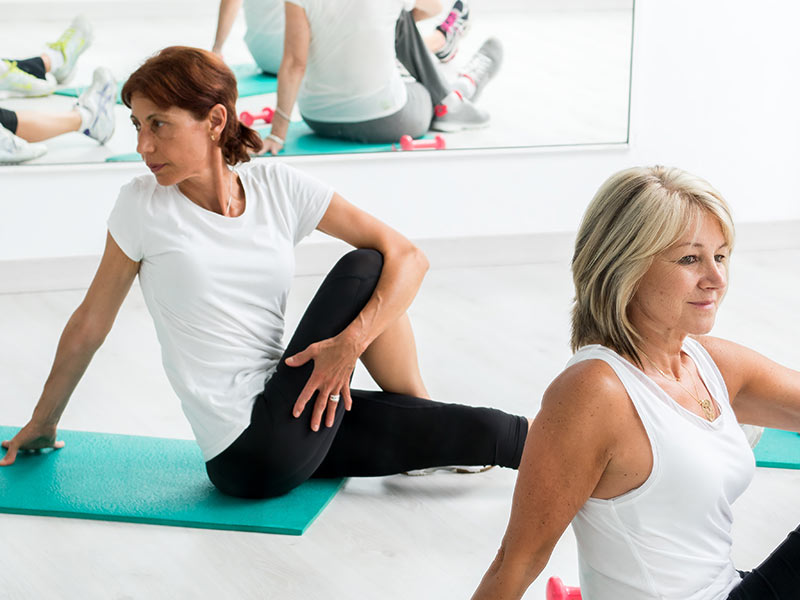
What are the benefits of exercise for menopausal symptoms? It cannot be overstated enough that what you get from exercising is increased mental alertness, the ability to perform daily tasks without getting breathless or tired, greater flexibility, more energy and vitality, faster reactions times, increased immunity, and stronger bones. Exercise is also a great stress buster 😊.
Achieving these takes time and effort but is a small price to pay for such huge rewards.
Try anything that gets you moving, as this will help improve your energy levels, reduce symptoms of depression, anxiety, and insomnia, and boost your well-being.
What are the best types of exercise?
1 = Aerobic exercise means anything that increases your heart rate and breathing rate, which will help protect against heart disease. The minimum is 150 minutes of moderate activity or 75 minutes of vigorous exercise a week. Moderate activity means you can still talk but not sing 😊 and vigorous means talking becomes a challenge, and singing is probably out the window.
2 = Weight-bearing and strengthening exercise – with moderate impact activities in which you support your body weight, such as jogging, dancing, walking, or tennis. Working your upper body through strength training- helps strengthen your body, which helps protects you from osteoporosis. Even dancing to your favourite music will help release endorphins – the feel-good hormones – helping shed the extra pounds we are vulnerable to gaining in midlife. The goal is to target all major muscles groups for 2 to 3 days a week.
Exercising is particularly important at menopause, as our metabolism (which means the rate at which our body burns calories) tends to slow down – and it can feel now like you only have to look at a piece of cake and the pounds go on!!
So how does exercising help?
It can help in several ways – 1) it allows you to burn more calories while you are doing it, and it can also increase your metabolic rate for 24hrs afterward- so you carry on using calories. 2) Regular exercise, particularly strength training or resistance training – which includes activities like pilates, yoga, HIIT, swimming and cycling, and weight training – all build muscle. So, why does this help? – well, the greater your muscle mass means, the higher your metabolic rate is, and you are then burning more calories even when you are not exercising 😊
You need to make time for exercise as part of your everyday lifestyle to help protect you from heart disease and dementia and build new bones. And if you do not exercise, you can feel old before your time.
But do not worry – you don’t have to start running a marathon; the aim is to improve your fitness level over several months gradually. Choose an activity you enjoy so you have a good chance of sticking with it. Once you start, it is good to vary the type of exercise you do on different days of the week to target other parts of your body and help stave off boredom.
Within 12 weeks of starting any exercise regimen, you should feel more energetic, cope more effectively with stress, sleep better, fight off infections more successfully, and generally feel better.
To end on a positive note, a study found that menopausal women who were physically active had less depression and anxiety, fewer hot flushes, and night sweats.
And a bonus is that it also improves your circulation, so your skin will look better and radiant.
Download Meno Mojo’s Beat your meno muffin top naturally guide – with six steps to succeed and reclaim your wellbeing
© meno mojo | Sitemap | Privacy Policy | Cookie Policy | Terms & Conditions | Website by Design M
| Cookie | Duration | Description |
|---|---|---|
| cookielawinfo-checkbox-analytics | 11 months | This cookie is set by GDPR Cookie Consent plugin. The cookie is used to store the user consent for the cookies in the category "Analytics". |
| cookielawinfo-checkbox-functional | 11 months | The cookie is set by GDPR cookie consent to record the user consent for the cookies in the category "Functional". |
| cookielawinfo-checkbox-necessary | 11 months | This cookie is set by GDPR Cookie Consent plugin. The cookies is used to store the user consent for the cookies in the category "Necessary". |
| cookielawinfo-checkbox-others | 11 months | This cookie is set by GDPR Cookie Consent plugin. The cookie is used to store the user consent for the cookies in the category "Other. |
| cookielawinfo-checkbox-performance | 11 months | This cookie is set by GDPR Cookie Consent plugin. The cookie is used to store the user consent for the cookies in the category "Performance". |
| viewed_cookie_policy | 11 months | The cookie is set by the GDPR Cookie Consent plugin and is used to store whether or not user has consented to the use of cookies. It does not store any personal data. |